
How to Get Google Reviews: What My Auto Mechanic Taught Me
 Greg CrossSep 18, 202610 min read
Key takeaways
- Google Reviews didn't replace word of mouth — they gave it a bigger microphone by making personal recommendations public, searchable, and persistent.
- We live in a "review economy": before hiring a plumber, roofer, HVAC tech, or picking a restaurant, people check what past customers said — an old instinct Google simply scaled.
- Online reviews keep the credibility of traditional word of mouth while reaching people the business owner will never meet, at the exact moment they're searching.
- Chasing "more five-star reviews" misses the point — the written story under the stars (why the customer was happy) is what actually builds trust and drives calls.
- A single star is a score; a specific sentence like "the final bill matched the estimate" is a story, and stories are what move people to act.
I've worked in marketing since 2002. That's twenty-four years of websites, logos, branding, business cards, social media, campaigns, strategy, consulting, and content. I've done just about all of it.
So there's a little irony in the fact that one of the things I'm most passionate about today is something I barely thought about for the first fifteen years of my career: customer reviews. If you've ever wondered how to get Google reviews that actually build trust, this story is for you.
I've been working on Google Review strategies with clients for roughly the past eight years. But recently something happened in my own life that made me think much more deeply about reviews — and about the very old thing they're actually built on.
What Does a Good Auto Mechanic Have to Do With Marketing?
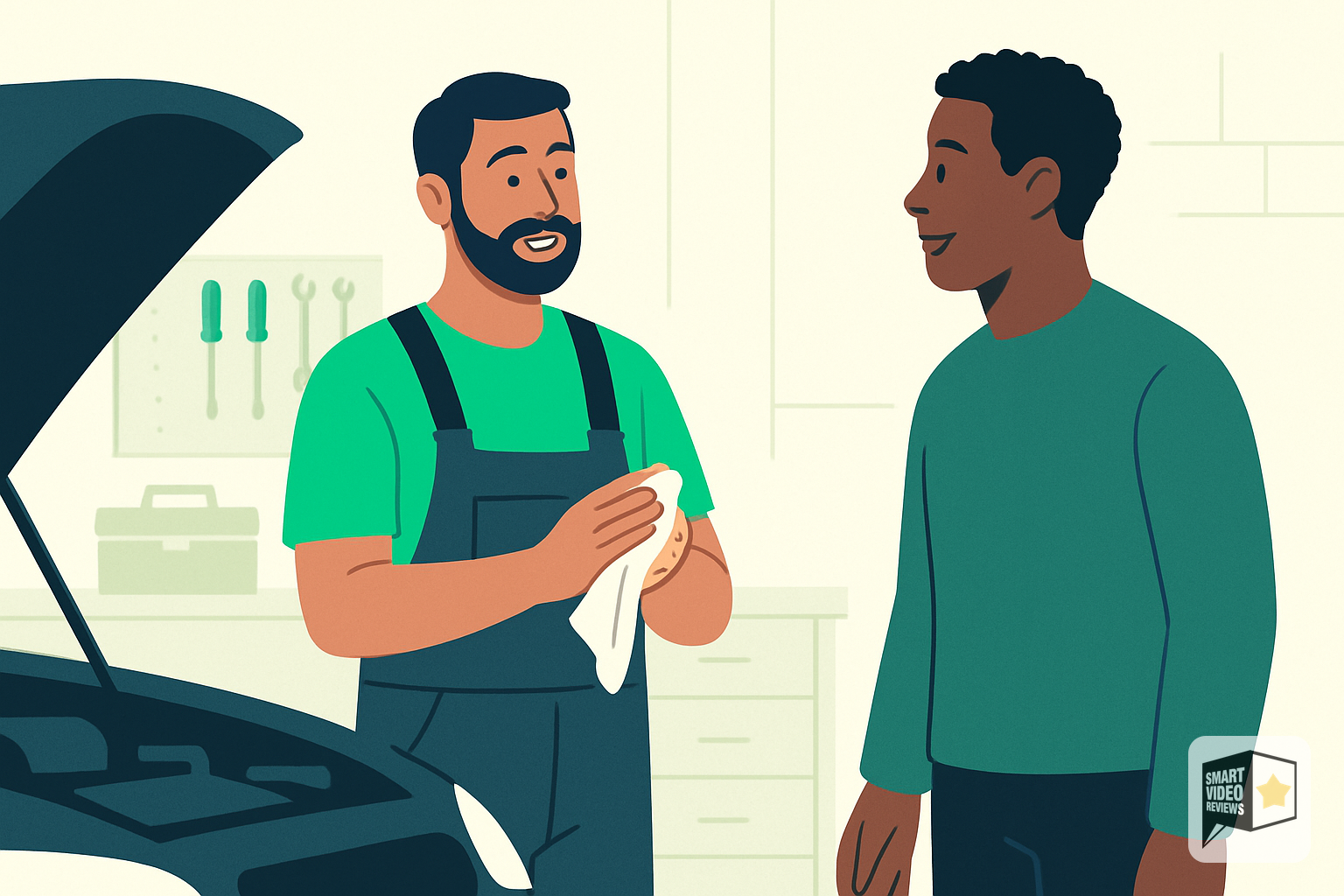
A while back I found an excellent auto mechanic named Evan. He goes to my church, and I've now taken vehicles to him a few times.
Every experience has reinforced my trust in him. Evan explains what's wrong with the vehicle. He takes the time to answer my questions. He doesn't talk over my head. He charges fair prices. And he makes me feel like I'm being treated honestly.
After another good visit, I told him something like: "Evan, you need to give me a way to express my appreciation."
The reason I said that matters. Evan doesn't really have a review strategy, and he hasn't made it easy for me to publicly share my experience.
I still intend to recommend him. If someone at church asks, "Do you know a good mechanic?" I'll say, "Call Evan." That's traditional word of mouth, and it's powerful.
But it's also granular. I tell one person. Then maybe another. Maybe someone asks me six months from now and I recommend him again. Those personal recommendations are extremely valuable — but their reach is naturally limited.
Why Did One Conversation Change How I See Reviews?
Standing there talking to Evan, a simple thought hit me. What if I could go to his Google Business Profile tonight and write exactly what I think about him?
I could explain that he's honest, that he takes time to walk me through repairs, that he charges fairly, that he answers my questions, and that he's earned my trust.
Something changes in that moment. I'm no longer telling only one friend. My recommendation becomes public.
Someone searching for an auto mechanic next week might see it. Someone six months from now might see it. Someone I've never met — and never will meet — might read about my experience while trying to decide whether Evan is a person they can trust.
My appreciation hasn't changed. My experience hasn't changed. The credibility of the recommendation hasn't changed. What changed is the reach.
That's the whole idea I want to explore here. Google Reviews didn't replace word of mouth. They gave word of mouth a bigger microphone.
What Do We Mean by a "Review Economy"?

We increasingly live in a review economy. Before hiring a plumber, an HVAC company, a roofer, an electrician, a restoration contractor, a landscaper, or a painter — before picking a restaurant or an auto shop — people look at what previous customers have said.
But here's the part worth pausing on: this behavior isn't new. Not even a little.
People have always asked each other the same questions.
- "Who do you use?"
- "Do you know somebody you trust?"
- "Have you ever worked with these guys?"
- "Who would you recommend?"
Google didn't invent that instinct. Google scaled it.
Online reviews took one of the oldest forms of marketing — word of mouth — and made it searchable, public, persistent, and scalable. The conversation over the backyard fence didn't disappear. It just found a way to be heard by more people, for longer.
How to Get Google Reviews That Beat Traditional Word of Mouth
I want to be careful here, because I don't think online reviews replaced personal recommendations. Traditional word of mouth is still one of the most powerful things going. It's personal, trusted, authentic, and credible.
Its main limitation is simply that it usually happens one conversation at a time.
A Google Review can keep all of those good qualities while dramatically expanding the audience.
- A spoken recommendation often disappears after the conversation ends. A written review can keep communicating that recommendation months, or even years, later.
- A spoken recommendation usually requires someone to ask, "Do you know somebody?" An online review can appear at the exact moment a potential customer is already searching for that service.
That last point is important. The customer isn't being interrupted by advertising. They're already looking. And now they're hearing from someone who has actually experienced the business.
If you want to understand the mechanics of how your profile shows up in those moments, Google's own Google Business Profile Help is a genuinely useful place to start.
Is the Goal Really "More Five-Star Reviews"?
I'd like to gently challenge how a lot of local businesses think about this.
Too many owners frame the whole thing as: "We need more five-star reviews." But learning how to get Google reviews that actually convert is about more than a number.
Stars matter, but the real opportunity is bigger than accumulating them. A five-star rating tells someone one thing: this customer was happy. The written story underneath those stars tells someone something far more persuasive — why they were happy.
Think about the difference between a star and a sentence like:
- "They showed up when they said they would."
- "They explained exactly what was wrong."
- "They didn't try to sell me something I didn't need."
- "They cleaned everything up when they finished."
- "The final bill matched the estimate."
- "They answered all my questions."
- "I finally found someone I trust."
Those details are where trust actually gets built. They're the digital version of a neighbor leaning over the fence and saying, "You should call these guys."
A single star is a score. A specific sentence is a story. And stories are what move people to pick up the phone.
Why Should a Customer's Story Stop at the Google Profile?

Here's where my thinking went next, and it's a natural question to ask.
If Google Reviews gave word of mouth a bigger microphone, why should that microphone be limited to one place?
Consider what has already happened by the time a customer leaves a great written review. You did excellent work. You earned their trust. They took the time to describe their experience in their own words. The hardest part is already behind you.
That experience — that story a real customer chose to tell — could reach even more of the people who are trying to decide whether to trust you. It doesn't have to live only on your Google profile, where people find it only if they go looking.
This is where our work at Smart Video Reviews fits, and I want to describe it plainly rather than pitch it.
Smart Video Reviews takes the authentic five-star Google reviews a business has already earned and turns them into short, branded videos with an AI voiceover. You can download those videos and post, share, or embed them wherever your future customers spend their time.
Notice what's not happening here. The business isn't inventing a testimonial. It isn't writing marketing copy and pretending a customer said it. The customer already supplied the message. We're just helping more people hear it.
The progression looks like this:
- Great customer experience
- Word of mouth
- A Google Review
- That review amplified through video
- Greater reach
Every step is grounded in something real that already happened. That's the part I care about most. If you want to keep exploring how reputation and social proof work for local businesses, there's more on the Smart Video Reviews blog.
What's the Better Question for Business Owners to Ask?
Let me bring this back to Evan.
I want to tell people he's an excellent mechanic. I'll absolutely keep recommending him in person. But I'd also love the chance to publicly document that experience, so someone I'll never meet — someone anxiously searching for a mechanic they can trust — can benefit from it too.
Now turn that around and point it at your own business.
Your customers may already love what you do. They may already be recommending you to friends, neighbors, coworkers, and family. That word of mouth is happening whether or not you're aware of it.
So maybe the question isn't simply, "How do I get more five-star reviews?"
A better question might be: "How easy am I making it for the people who appreciate my business to tell the world about it?"
Evan is a great mechanic who hasn't made that easy yet. A lot of great local businesses are in the same spot. The good news is that this is a fixable problem, and fixing it doesn't require you to become a marketer. It just requires you to stop leaving your best word of mouth trapped in one-on-one conversations.
Here's the lesson I keep coming back to after twenty-four years in this field — and I'm still learning it. Do great work. Treat people well. Earn their trust. Give them an easy way to tell their story. And once they've told it, don't be afraid to help that story travel farther.
Because Google Reviews didn't replace word of mouth. They gave word of mouth a bigger microphone.
Frequently Asked Questions
Did online reviews make traditional word of mouth obsolete?
No. Personal recommendations are still incredibly powerful because they're built on trust between people who know each other. Online reviews don't replace that — they extend it. A Google Review lets one customer's honest recommendation reach people far beyond their immediate circle, and it keeps working long after a single conversation would have ended.
Why does the written part of a review matter more than the star rating?
A star rating tells someone a customer was happy. The written review tells them why. Specific details — showing up on time, explaining the work, honoring the estimate, cleaning up afterward — are where trust actually gets built. Those sentences are the digital equivalent of a neighbor telling you exactly which company to call.
What does Smart Video Reviews actually do?
Smart Video Reviews takes the genuine five-star Google reviews your business has already earned and turns them into short, branded videos with an AI voiceover. You can download the videos and post, share, or embed them wherever you like. The customer's words stay authentic — the tool simply helps more people encounter them.
Does Smart Video Reviews post the videos to my social media for me?
No. Smart Video Reviews creates the videos and gives you the files to download. You decide where and when to post, share, or embed them. That keeps you in control of your channels and your messaging.
How should I encourage customers to leave reviews without being pushy?
The most natural approach is to simply make it easy. Many happy customers want to express appreciation but don't know how — the way I felt with my mechanic. If you're figuring out how to get Google reviews, give them a direct link to your Google Business Profile after a good experience, and let them know a quick note about what stood out would genuinely help others find you.
I'm a home-service business. Is any of this relevant to me?
Very much so. HVAC companies, plumbers, roofers, electricians, restoration contractors, landscapers, painters, remodelers, and pest-control businesses all live and die on trust and reputation. When a homeowner is searching for someone reliable, a specific, believable review — especially one they can watch — can be the difference between getting the call and being scrolled past.
This article makes the case that the written story behind a five-star rating — "they showed up on time," "the bill matched the estimate" — is what actually earns trust. Smart Video Reviews takes those real 5-star Google reviews and turns them into short, branded videos with an AI voiceover, so a customer's words don't just sit on your profile — they become shareable social proof you can put on your website, social feeds, and ads.
In a review economy, reach matters. Smart Video Reviews gives your best customer stories an even bigger microphone, carrying the same authentic recommendations to people who are already deciding whether they can trust you.
SmartVideoReviews.com can turn the honest stories behind your five-star Google reviews into short, branded videos that carry your best word of mouth far beyond a single profile.
Watch the walkthrough
Your 5-star reviews are gold. We turn them into videos that sell.
See a real Google review become a branded, ready-to-post video — no camera, no crew, no editing.
See how it works → 2:50
2:50Keep reading

Start With the Customer: The Steve Jobs Marketing for Local Contractors Lesson Missed
Most local contractors market their features. Steve Jobs started with the customer and worked backward. Here's how to do the same.
How to Use Customer Reviews: They're Inventory, Not Trophies
Home services owners earn reviews the hard way, then leave them on a shelf. Here's how to treat a review as an asset you can spend everywhere.
When the Floodwaters Rise, Homeowners Search 'Water Damage Restoration Near Me': Will They Trust Your Company?
After a flood, homeowners search Google in a panic. Here's how restoration companies earn trust fast with reviews, response, and video proof.