
Why the Ideal Google Review Rating Isn't a Perfect 5.0
 Greg CrossSep 23, 202611 min read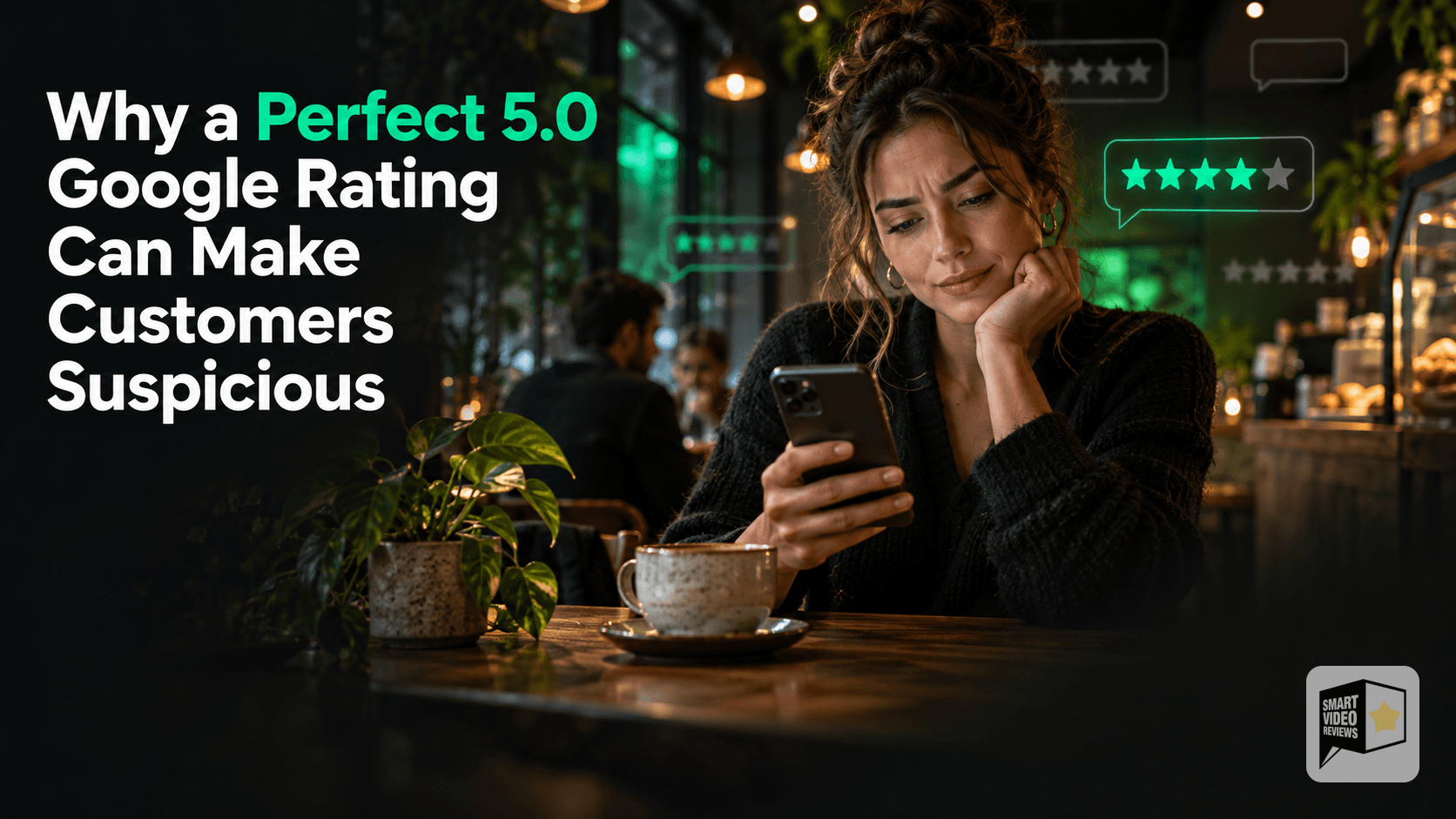
Key takeaways
- A flawless 5.0 rating can trigger suspicion because today's consumers have learned to spot fake or curated reviews — a 4.8 with detailed responses often builds more trust.
- Prospects aren't asking "Is this company perfect?" — they're asking "Can I trust these people?"
- "Texture" — specific, unscripted details customers include (arrival time, cleanup, honest pricing) — is what turns a review into real social proof.
- A thoughtful owner response to a negative review can reveal accountability and humanity, converting a complaint into a trust signal.
- Your own responses are an overlooked marketing voice; fixing them is often cheaper and higher-impact than buying more ads.
Here's something most local business owners don't want to hear: a flawless 5.0 review profile can actually make people suspicious. A blend of strong ratings and thoughtful owner responses is often seen as more credible than a spotless score alone, and that combination can help earn customer trust.
That sounds backwards. We're all taught to chase the perfect score. But today's consumers have seen fake reviews, purchased reviews, and manufactured testimonials for years now. They've learned to recognize when something feels a little too clean.
They may not be able to explain why they distrust a wall of perfect ratings. They just don't quite believe it. And for a home-service business asking a stranger to trust you inside their home, that hesitation costs you jobs.
Why does a perfect rating feel suspicious?

Picture a review profile that's nothing but five stars and one-line praise:
- When reviews all sound identical and generic, prospective customers start to wonder whether they're real, which is exactly why a flawless slate of praise can quietly erode trust.
There may be nothing dishonest about any of those reviews. But they lack texture. And real customer relationships have texture.
Sometimes a customer is thrilled. Sometimes there's a misunderstanding. Sometimes a job doesn't go exactly to plan. Sometimes the business makes a mistake and fixes it. A prospect can feel the difference between a reputation that was lived and one that was curated.
What a prospect really wants to know isn't, "Has this company achieved absolute perfection?" They're asking a very different question: "Can I trust these people?"
Should you stop chasing five-star reviews?
No. Let's be clear about this, because it's easy to misread the point.
You should absolutely pursue five-star customer experiences and encourage happy customers to share them. And you should never welcome a bad review just to make your profile look more "real." That would be silly.
The argument here isn't about numbers. It's about credibility versus numerical perfection. A business with an overwhelmingly positive reputation, specific customer stories, a couple of imperfect experiences, and thoughtful responses can tell a prospect more about its character than a sterile wall of identical five-star lines ever could.
What is "texture" in a review, and why does it matter?
Texture is the specific, unscripted detail that a business could never have written itself.
- One customer mentions how quickly the technician arrived.
- Another says the tech stayed an extra twenty minutes explaining the problem.
- Another admits the company wasn't the cheapest estimate, but they felt comfortable choosing them anyway.
- Another notes that the crew cleaned up before leaving.
- And when a customer writes about finally finding a contractor they trust, that authentic sentiment builds far more credibility than a flawless score ever could.
Those details are the social proof. They're powerful precisely because the business didn't write them. The customer did.
That's the whole distinction. Advertising is the business telling the market, "We're trustworthy." Social proof is the customer telling the market, "I trusted them, and here's what happened." One is a claim. The other is evidence.
Can a negative review actually help your ideal Google review rating?

Imagine a homeowner researching a local contractor with a strong 4.8 rating. There are hundreds of positive reviews. Then they spot a two-star review. Something clearly went wrong.
Most owners assume that review is the problem. But the prospect isn't necessarily focused on the complaint. They're often scrolling for something else entirely: "How did the company respond?"
Now imagine they find this underneath (a hypothetical example, but a realistic one):
A perfect string of five-star reviews can actually read as suspicious, since genuine businesses inevitably field the occasional off day and imperfect interaction.
That response tells the prospect something a star rating never can. It reveals accountability, communication, empathy, and professionalism. Most importantly, it proves there's a real human being behind this business.
Suddenly that two-star review didn't hurt the company. The response turned it into a trust signal.
Are you overlooking your most important marketing voice?
Business owners spend enormous energy thinking about what customers write in their Google reviews. But almost nobody thinks about the other voice on that page: their own.
Your responses may be one of the only places on your Google Business Profile where a prospective customer gets to hear how you actually communicate.
How do you respond when someone compliments your employee? When someone trusts you with their home? When something goes wrong? Do you sound grateful, or defensive? Human, or corporate? Or is there simply silence?
Silence is a missed opportunity. And it's one of the cheapest, highest-impact things you can fix.
Would you rather fix your responses or buy more ads?
Honestly, I'd rather see a lot of businesses fix the way they respond to customers before spending another dollar on advertising.
Here's the logic. Advertising asks people to believe what the business says about itself. Google reviews show what customers say about the business. And the owner's response shows prospects who the business actually is.
Put those three together and you have something advertising alone can never buy.
What makes a Google review "social proof" instead of just a rating?
A great Google review isn't merely another five-star tally mark. It's social proof.
A real person hired you. A real service was performed. A real experience occurred. And the customer voluntarily documented it. That's why the words inside a review matter far more than the star count.
The customer is often answering the exact concern the next prospect is quietly worrying about:
- Your real Google reviews already contain the specific, credible details customers care about — clear explanations up front, no upselling, on-time arrivals, and quotes that match the final price.
Those aren't advertising claims. They're lived customer experiences. That is what makes them believable.
What if your best social proof could leave your Google profile?
Here's the frustrating part: your strongest social proof is usually buried. It's sitting inside your Google Business Profile, waiting for someone to happen to scroll far enough to find it.
So ask a better question. What if that customer's story could become content you actually share? And what if you could personally respond to that story inside the same piece of content?
That's where Smart Video Reviews becomes more than "turning a review into a video." A Smart Video Review can bring together two very important voices.
Voice one: the customer
The customer's authentic Google review provides the social proof. You didn't invent the experience. You didn't write the testimonial. The customer did. Their words become the foundation of the content, and they stand entirely on their own.
Voice two: the business owner
Smart Video Reviews includes a cloned-voice capability, which lets your own voice participate in the content to affirm the customer's experience and express genuine appreciation.
Conceptually, the customer says, "Here's what happened when I hired this company." Then you respond, "Thank you. We appreciate your trust, we're grateful you chose us, and we're glad our team delivered that experience."
This part matters, so read it carefully: your voice does not replace the customer's voice, and it never pretends to be the customer. The review remains the customer's social proof. Your cloned voice simply adds the affirmation, appreciation, and humanity on top of it.
Why is this a different kind of marketing?
Line up the three messages and the difference becomes obvious.
A traditional advertisement says, "We're great. Trust us."
A Google review says, "I hired them. Here's my experience."
A Smart Video Review takes that earned social proof and lets you respond, "We're grateful you trusted us, and we're proud our team delivered that experience."
That's not manufactured praise. It's not a business writing a testimonial for itself. It's a business amplifying social proof it already earned. That's a meaningfully different — and more honest — kind of marketing.
Doesn't AI video contradict the whole "authenticity" argument?
This is the fair objection, so let's address it head-on. If perfection feels fake, doesn't polishing a review into a produced video also feel fake?
It would, if the goal were to make your business look more perfect. But that's not the point. The power of a Smart Video Review isn't that it makes you look more polished. It's that it makes an authentic customer experience more visible.
A real review. A real experience. The customer's actual words. Then your own voice expressing real appreciation for it. The technology isn't being used to manufacture authenticity — it's being used to amplify something authentic that already happened. That's the whole philosophical thread connecting the start of this article to the end of it.
You keep the video, you download it, and you decide where it lives — your feed, your website, an email, wherever it fits. If you want to see the mechanics, our FAQ walks through exactly what's included and what's up to you.
How do you find a review worth turning into video?

Here's a practical challenge you can do in the next five minutes. Go to your Google Business Profile right now.
Don't just look for your newest five-star review. Find one with a story. Look for the review where someone explains:
- what problem they had,
- why they called you,
- what your employee actually did,
- what surprised them,
- what made them trust you,
- or why they'd recommend you to a neighbor.
That's the one. Because that's not just another rating. That's social proof.
Then take that review and turn it into a Smart Video Review. Let the customer's words tell the story. Let your branding identify your business. And use the cloned-voice feature to add your own authentic response — thank the customer, recognize your team, and affirm the experience so prospects can hear the human behind the business.
Once the video is yours, share it across your social channels and other digital marketing where it fits. Now you're no longer waiting for someone to stumble across that great story on Google. You're helping the story travel. If you want more ideas like this, our blog covers practical ways local businesses put their reviews to work.
Where does all of this actually leave you?
Bring it down to three voices.
Advertising says: "Trust us." A Google review says: "I trusted them." A Smart Video Review says: "Here's the proof — and here's the business owner personally thanking the customer for trusting us."
That's the difference.
So stop trying to manufacture credibility. The ideal Google review rating comes from trust your customers may have already created for you. It's sitting inside your Google reviews right now. Find the stories that demonstrate why people trust your business. Respond to them. Appreciate them. And turn them into content so more people can see — and hear — the social proof you've already earned.
The customer provides the proof. Your voice provides the affirmation. Smart Video Reviews helps both travel farther. When you're ready, you can start a free trial and turn your first real story into a Smart Video Review.
Frequently Asked Questions
Is a 4.8 rating really better than a 5.0?
Not automatically. The point isn't the number itself — it's credibility. A profile with specific, detailed customer stories and thoughtful owner responses often reads as more trustworthy than a wall of identical, generic five-star lines. Keep pursuing great experiences; just make sure your reviews and responses show real texture.
Does the cloned voice pretend to be my customer?
No. The customer's review is their social proof and their words stay theirs. The cloned-voice feature represents you, the owner, responding to and appreciating that review. It never impersonates the customer — it adds the "we heard you, we appreciate you, thank you for trusting us" layer on top of an authentic story.
Does Smart Video Reviews post the videos to my social media for me?
No. Smart Video Reviews turns your Google reviews into short, branded videos with AI voiceover that you can download, post, share, and embed. The posting and distribution is up to you, so you stay in control of where and when each video appears.
Should I respond to negative reviews before making videos?
It's a smart place to start. A calm, accountable response to a critical review can build more trust than the review costs you, because it shows prospects how you handle problems. Fixing your response habits is often the highest-impact, lowest-cost reputation move you can make.
What kind of review makes the best video?
Choose reviews with a story rather than a slogan — ones that mention the problem, why the customer chose you, what your team did, and what earned their trust. Those specifics answer the questions your next prospect is already asking, which makes them far more persuasive than "Great service, five stars."
How do I encourage customers to leave detailed reviews?
Ask at the right moment, right after a job goes well, and gently prompt for specifics: what problem you solved and what stood out. Google's Business Profile help covers how to request reviews within their guidelines. More detailed reviews give you both stronger social proof and better raw material for video.
The article makes the case that credibility beats numerical perfection — and that the words inside a review carry more weight than the star count. Smart Video Reviews takes your genuine 5-star Google reviews and turns them into short, branded videos with AI voiceover, so the specific, lived details customers wrote actually get seen instead of buried under a wall of identical one-liners.
Because these videos feature real customer language — the arrival that was on time, the honest quote, the crew that cleaned up — they carry the same texture that makes a review believable. Share them on your website and social channels to show prospects the evidence behind your rating. You can start a free trial or learn more about how it works.
SmartVideoReviews.com can turn the specific, trust-building details inside your best Google reviews into short branded videos that show prospects exactly why real customers chose you.
Watch the walkthrough
Your 5-star reviews are gold. We turn them into videos that sell.
See a real Google review become a branded, ready-to-post video — no camera, no crew, no editing.
See how it works → 2:50
2:50Keep reading
How to Get Google Reviews: What My Auto Mechanic Taught Me
Google Reviews didn't replace word of mouth. They gave it a bigger microphone. Here's what that means for your local business.

Start With the Customer: The Steve Jobs Marketing for Local Contractors Lesson Missed
Most local contractors market their features. Steve Jobs started with the customer and worked backward. Here's how to do the same.
How to Use Customer Reviews: They're Inventory, Not Trophies
Home services owners earn reviews the hard way, then leave them on a shelf. Here's how to treat a review as an asset you can spend everywhere.